Planning team building for an engineering or manufacturing team in Ireland? Start with the working reality of the group. Site-based teams, engineers, quality, operations, maintenance, supply chain, R&D and office functions may spend the working week in very different environments, so the event needs to create common ground without feeling forced.
Event Square’s approach is practical and low-tech. We use physical challenges, collaborative problem-solving, creative tasks and structured team-development formats that get people working together away from normal roles. The activity should fit the people, the venue and the purpose of the day — not the other way around.
Why engineering and manufacturing teams need the format to be practical
Ireland continues to attract investment across engineering, advanced manufacturing and technology. In 2026, IDA Ireland highlighted new and expanding engineering and R&D activity across the country, while Government policy also moved ahead with Next Generation Sites intended to support future large-scale manufacturing investment.
For an individual team, however, the important point is simpler: these organisations often bring together people with different roles, routines and technical perspectives. A team event should give everyone a useful way to participate, rather than favouring the loudest voice, the fastest runner or the most senior person in the group.
What team-building activities work well for engineering and manufacturing groups?
Collaborative problem-solving
Beat the Clock is a useful option when you want teams to organise themselves quickly, divide tasks, communicate clearly and adapt under time pressure. It works well in a meeting room or conference setting and does not require a large outdoor site.
Building one shared outcome
Big Picture gives separate teams responsibility for different parts of one final result. That structure can work particularly well when the event objective is to reinforce the idea that individual workstreams need to connect across a wider organisation.
Mixed physical, mental and practical challenges
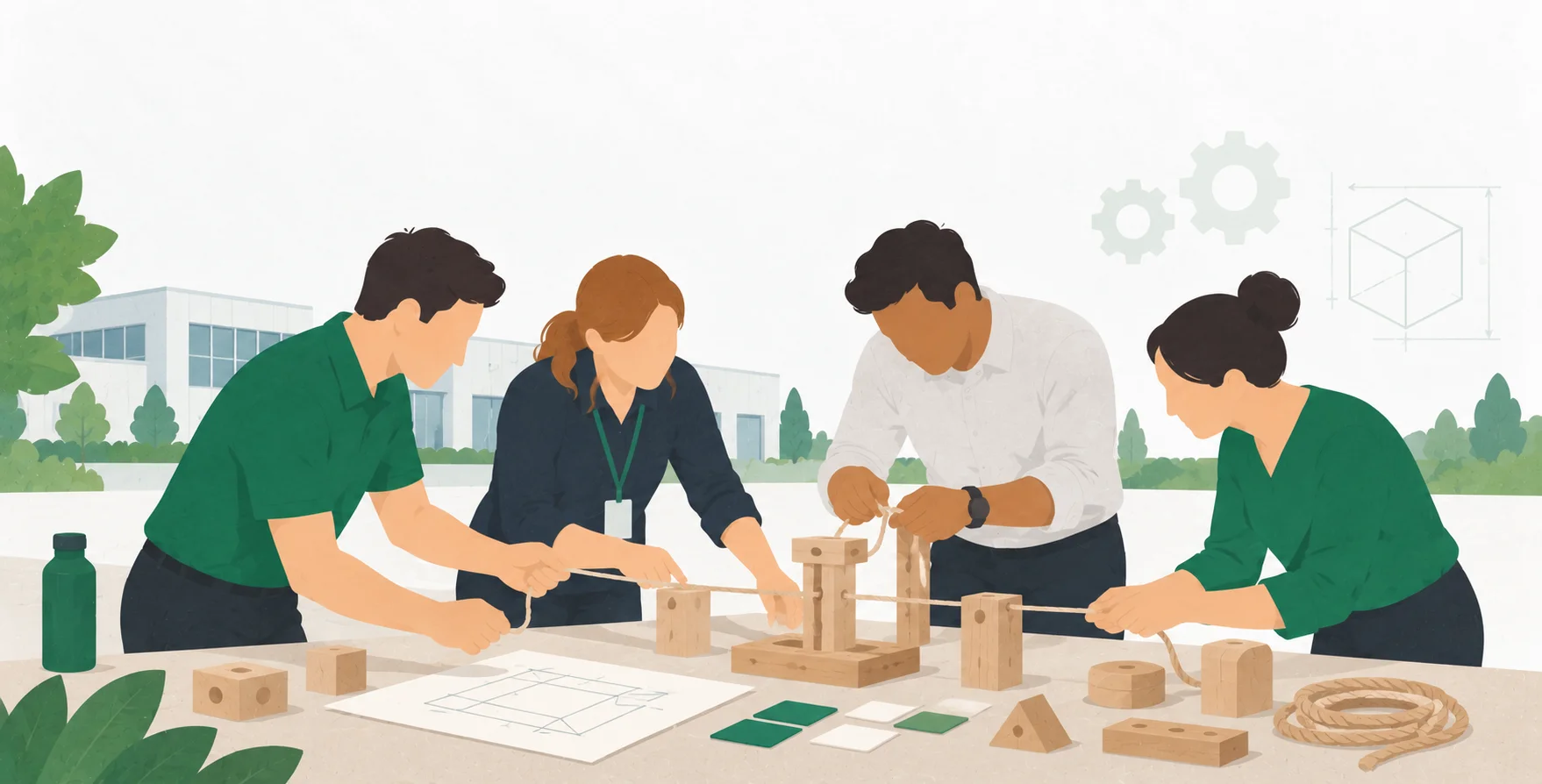
The WeGo Team Challenge combines different challenge types so the same skillset does not dominate every round. Teams may need to plan, communicate, coordinate, solve and build, giving different people opportunities to contribute.
Team development with a clearer framework
For leadership groups, project teams or newly formed teams, The Belbin® Experience adds a structured team-role framework to practical challenges. This is a better fit when the event needs more than a social outcome and the group wants to discuss how different behavioural strengths contribute to team performance.
Outdoor company days
If you have suitable grounds and a larger time window, formats such as Old School Sports Day or Celtic Games can create a more relaxed company-day atmosphere. For mixed workforces, we normally balance physical activities with skill, coordination and problem-solving so participation is not dependent on fitness alone.
Should the activity be technical or engineering-themed?
Usually, not heavily. Teams do not need another version of their normal work disguised as a game. The most useful activities often create familiar behaviours — planning, communication, resource allocation, testing, adapting and handing information between people — without reproducing live technical tasks.
If a conference or company theme matters, we can incorporate it at a high level. We avoid using confidential process information, live operational data or proprietary technical details as event content.
How do you include production, office and technical teams in the same event?
Do not build the programme around job titles. Mix teams deliberately and choose challenges with different routes to success. One activity may reward careful planning, another coordination, another creativity and another communication.
This is particularly useful where colleagues know one another by email, shift handover or project meeting but rarely spend time working together outside the normal operating structure. The activity gives them a shared problem that is neutral territory.
Planning around shifts and operational schedules
For site-based organisations, timing is often the first constraint. A full-day event may not be realistic for everyone at once. In that case, it can be better to run a focused session for one cohort, repeat the same programme for another group, or combine a shorter activity with an existing meeting or company gathering.
Consistency matters if different groups attend at different times. Briefing, challenge difficulty and scoring should be kept as comparable as possible so the experience does not feel noticeably different between cohorts.
Can team building happen on a company site?
Sometimes, yes — but the activity space needs to be clearly separated from live operations, vehicle movements, production areas and other site hazards. We only use areas approved for the event by the organiser and venue or site contact.
If the available on-site space is limited, an indoor meeting room may suit indoor team building, while a nearby hotel or event venue may be a better option for a larger programme.
How long should the session be?
- 30–60 minutes: suitable for a conference energiser or focused collaborative task.
- 90 minutes–2 hours: enough for a structured problem-solving session with a proper briefing and finish.
- 2–3 hours: useful for rotating teams through a broader challenge programme.
- Half day: suitable for a more substantial team session or department event.
- Full day: best when team building is part of a wider company day, meeting, lunch or social programme.
The right answer is the duration your operation can genuinely protect. A shorter programme that runs properly is better than an overfilled agenda.
What works for graduate engineers and early-career hires?
Graduate groups often benefit from a more structured onboarding format rather than a standalone social. Graduate Grow is designed around communication, collaboration, confidence, self-awareness and the transition into the workplace.
The aim is not to test technical knowledge. It is to help new hires understand how they contribute within teams and how they work with colleagues whose roles and approaches may be different from their own.
What should organisers tell us before we recommend a programme?
- group size and approximate mix of roles;
- event date and location;
- time available;
- whether the event is on-site, at a hotel or at another venue;
- usable indoor and outdoor space;
- the main objective for the day;
- any accessibility or participation requirements;
- whether groups need to attend in separate cohorts because of shifts or operations.
Those details let us narrow the activity list quickly and avoid suggesting formats that will not work in the available space or timetable.
Why Event Square keeps it experiential
Engineering and manufacturing workplaces can already be full of systems, dashboards, processes and technology. Team building does not need to add another screen. A physical challenge, shared build, map, set of clues or practical problem can create a useful change of pace because people have to communicate directly and make decisions together.
That low-tech approach is not anti-technology. It simply gives the team a different environment in which to interact.
Planning an engineering or manufacturing team event in Ireland
Tell us the location, group size, event objective, time available and whether you need the programme to work around shifts or an existing meeting. We can recommend practical indoor, outdoor or mixed options and shape the event around the venue and workforce rather than forcing a standard package.
Plan your engineering or manufacturing team event →
Frequently asked questions
What is a good team-building activity for engineers?
Problem-solving and collaborative build-style activities usually work well because they create a clear task without relying on sporting ability. The best choice still depends on group size, time, venue and the reason for the event.
Can you run team building at a manufacturing site?
Potentially, yes, if the organiser provides a suitable approved event area that is separate from live operational hazards. We review the activity space and access requirements before confirming the format.
Can the same event be repeated for different shifts?
Yes. Where staffing or operations make one large session impractical, the same core programme can be repeated for separate cohorts, subject to timing and event setup.
Do we need an outdoor venue?
No. Indoor options can work well for engineering and manufacturing groups, particularly when team building is being added to a meeting, training day or conference.
Can the session include leadership or team-development objectives?
Yes. If the goal goes beyond a social event, a structured format such as Belbin or a facilitated challenge programme can connect the practical activity to communication, team roles and working relationships.