What should a leadership team away day achieve?
A leadership away day should not feel like a longer management meeting with lunch added, and it should not become a random collection of games because the team has left the office. Senior teams usually have limited time together, so the day needs a clear purpose.
In January 2026, Dublin Chamber reported that 78% of surveyed Dublin businesses operated a hybrid model, and its research also noted challenges around cohesion, onboarding and informal learning. That makes deliberate face-to-face time especially valuable, but an offsite still needs structure to be useful.
Before choosing a venue or activity, agree the primary objective. Is the team trying to improve communication, clarify roles, work through friction, integrate new leaders, strengthen cross-functional decision-making, reset after change or prepare for growth? The clearer the answer, the easier it is to design the day.
The best leadership team building is not necessarily the most dramatic
Senior groups do not need activities that make people feel self-conscious or force artificial enthusiasm. They need a credible challenge that creates useful behaviour to discuss.
That can be a physical planning task, a collaborative creative challenge, a problem-solving exercise or a structured team-development session. The useful material is what happens while the team is working: who takes control, how information is shared, how disagreement is handled, whether people listen, how decisions are made and what happens when the first plan fails.
This is where Event Square’s low-tech approach can work well. There is no dashboard to hide behind and no chat window to retreat into. The team has to communicate in real time.
1. Start with the leadership objective
- Role clarity and contribution: use a framework that gives people a shared language for discussing how they work.
- Communication and decision-making: use practical challenges where time pressure or competing ideas make behaviours visible.
- Collaboration across functions: choose tasks where no one sub-team can succeed independently.
- Trust and working relationships: create structured opportunities for reflection rather than relying only on competition.
- Strategy and alignment: protect enough meeting time for the actual business issues, then use the experiential element to reinforce how the team needs to operate.
2. Use Belbin when the team needs a shared language
The Belbin® Experience combines Belbin Team Roles with practical team-development activities. Participants complete the Belbin process before the session, then use their individual and team profiles to explore behavioural strengths, communication, role balance and contribution.
For leadership teams, the value is not in putting people into boxes. It is in giving the group a more neutral way to discuss questions that can otherwise become personal: who naturally drives action, who spots risks, who brings ideas, who keeps the group together, where contributions are being overlooked and where the team may have gaps or duplication.
The learning becomes more useful when it is followed by an experiential challenge and structured review. The team can compare what the profile suggests with what actually happened under pressure.
3. Use a collaborative challenge to expose silos
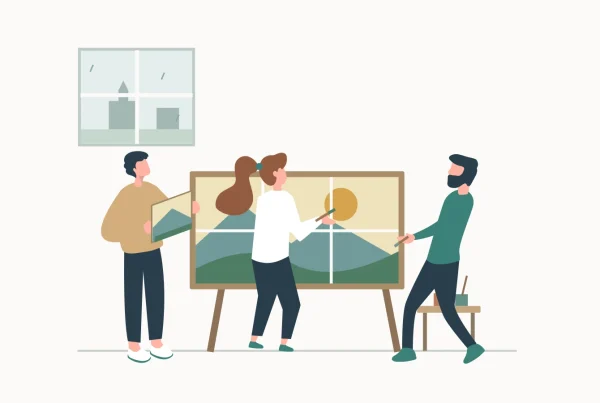
Big Picture is a collaborative task in which small groups each create one section of a larger image. The final result only works if neighbouring teams coordinate colours and lines.
For a leadership group, that creates a practical question: are people optimising their own piece or thinking about the whole? That can open a useful conversation about silos, shared outcomes and how functional leaders contribute to one leadership team.
4. Use time pressure carefully
Beat the Clock gives teams a pack of physical and mental tasks and a fixed amount of time. People have to divide work, track progress and decide when to persist, ask for help or change approach.
For a leadership group, the debrief matters more than the score. Without that, it is simply a game. With the right review, it can prompt useful questions about delegation, information flow, decision speed and whether the loudest voice becomes the default leader.
A practical structure for a one-day leadership offsite
- Arrival and context: agree what the team needs from the day and what is out of scope.
- Business session: strategy, priorities or decisions that require collective attention.
- Team-development input: a framework such as Belbin or a focused discussion about how the team is operating.
- Lunch and proper break.
- Experiential challenge: a practical task designed around the day’s objective.
- Facilitated review: what happened, what did the team notice and what mirrors the workplace?
- Application: agree a small number of behavioural or operating commitments.
- Close: confirm owners, follow-up and next steps.
The principle is more important than the clock: do not let the activity consume the learning, and do not let the meeting content consume the entire day.
Choosing the right venue
Leadership teams often focus on the boardroom and forget the rest of the day. The venue needs to support both conversation and activity.
- Choose a room where everyone can see and hear one another comfortably.
- Confirm whether breakout space is private rather than a public lobby.
- Check the exact room or outdoor area before the activity is agreed.
- Build in proper breaks rather than filling every minute.
- If the day is outside the office, protect the time from routine calls and interruptions.
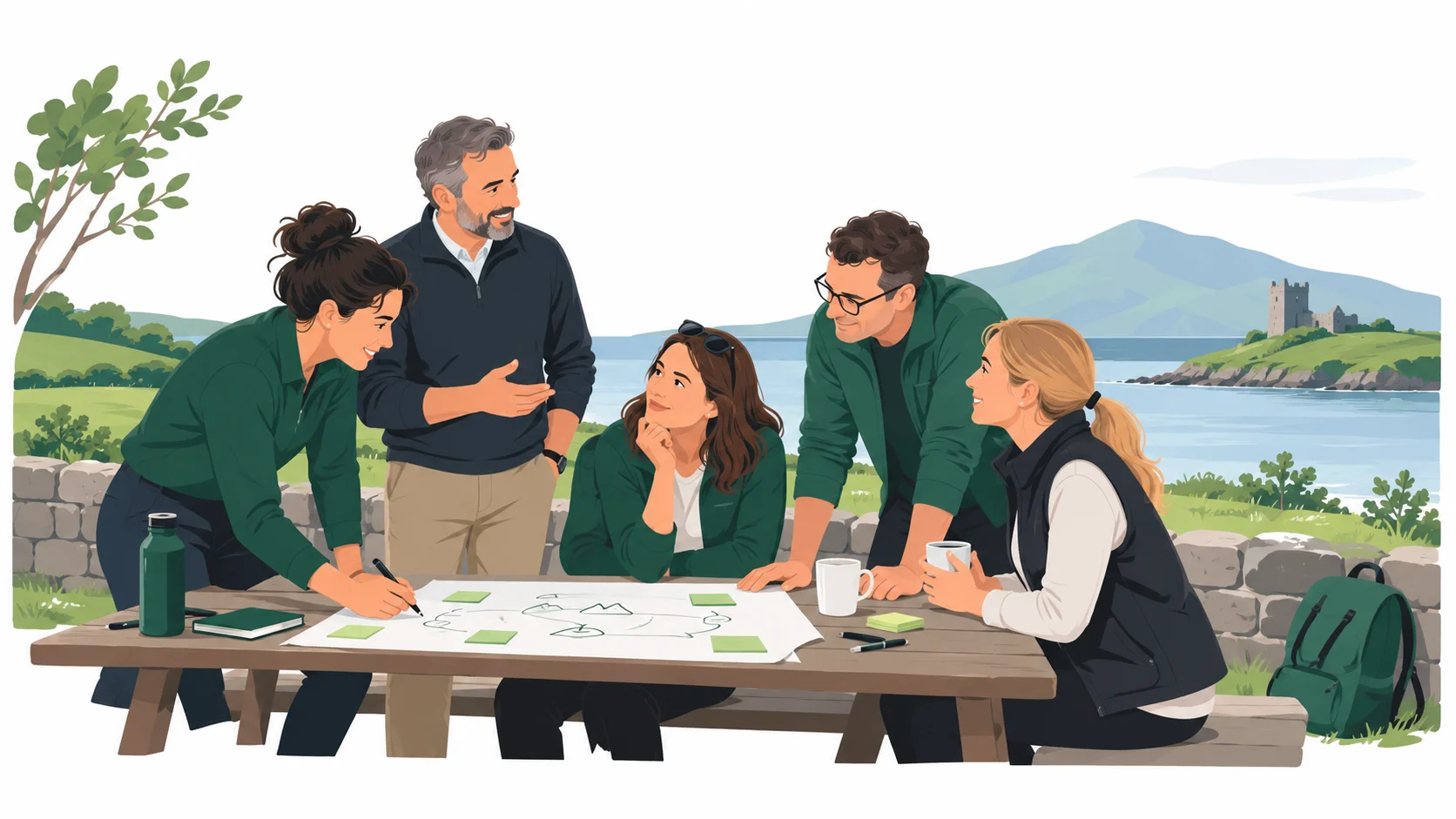
For teams considering a more rural format, Event Square’s guide to corporate away days in Wicklow covers the practical trade-offs between destination, travel, outdoor space and programme flow.
Common mistakes with senior management team building
Trying to fix everything in one day
A team with several competing challenges does not need a ten-point agenda. Pick the most important objective and design around it.
Choosing the activity before the objective
An activity should serve the brief. Something that looks fun online is not automatically the right leadership-development tool.
Skipping the debrief
The debrief turns activity into learning. Ask what happened, why it happened, what worked, what did not, and where the same pattern appears at work.
Leaving without follow-through
A useful away day should finish with a small number of clear commitments around meeting behaviour, decision-making, communication, delegation or how the team handles disagreement.
When a multi-day programme makes sense
One day can be enough for a focused reset or a specific team issue. A longer programme makes more sense when the objective is development over time and the group needs repeated opportunities to learn, test behaviours and reflect.
Event Square’s Tarmac 3-Day Leadership Development Programme used a progressive structure that moved from leadership concepts into practical challenges, observation, reflection and application. The lesson for planners is not that every leadership event should last three days, but that deeper development needs enough time to move beyond a single activity.
Why low-tech experiential learning suits leadership teams
Leadership work is increasingly mediated through screens: presentations, dashboards, messaging platforms and video calls. An experiential task changes the environment. People have to read the room, communicate directly and respond to what is actually happening rather than what is written in a slide deck.
Event Square’s approach is deliberately practical. The experience does not need complicated technology to create a useful discussion. Often, a well-designed physical task and a good review reveal more about a team’s habits than another hour of theory.
Frequently asked questions about leadership team away days
What is the best team building activity for senior leaders?
There is no single best activity. The right choice depends on the objective. Belbin can suit teams that need a shared language around contribution and roles; collaborative challenges can help with silos and shared outcomes; time-based problem solving can reveal communication and decision-making patterns.
How long should a leadership away day last?
A focused issue can often be addressed in one day. Broader leadership development may need multiple sessions or a multi-day programme so the team can revisit concepts, practise different behaviours and apply the learning.
Should a senior management offsite include strategy and team building?
It can, provided the two parts are connected. Use the strategy session to clarify what the business needs, then use the team-development element to examine how the leadership team needs to work in order to deliver it.
Can leadership team building be delivered at our hotel or office?
Yes, depending on the programme and space available. Event Square can deliver at suitable hotels, estates, offices and conference venues across Ireland. The room or outdoor space should be checked before the activity is confirmed.
Is leadership team building suitable for small executive groups?
Yes. Smaller groups can often go deeper because there is more time for discussion and reflection. The format should be designed for the actual number rather than scaled down from a large company event.
Do leadership activities have to be very physical?
No. Effective experiential learning can use tabletop problems, creative collaboration, planning exercises, facilitated team-role work and low-physical challenges. The activity should suit the group rather than test fitness.
Planning a leadership or management away day in Ireland?
Start with the outcome rather than the activity list. Event Square can build a practical team-development format around your leadership group, venue and wider agenda, from a focused experiential session to a more structured Belbin or multi-day programme.
See the Team Building & Corporate Events FAQ or contact Event Square about your leadership away day.