A corporate family fun day looks simple from the guest side.
People arrive, children head towards the activities, food opens, music starts and families move around the site at their own pace.
Behind that relaxed atmosphere is a surprisingly detailed operational plan.
Large family events have to work for toddlers, teenagers, parents, colleagues, partners and grandparents at the same time. They also bring together activity suppliers, entertainers, caterers, inflatables, power, waste, first aid, parking, weather decisions and food-allergy information.
That is why the best company family days are not built around one big attraction. They are built as a flow of experiences that families can enter and leave naturally.
This fits a wider workplace trend too. In May 2026, Ibec highlighted the role of sports and social committees in creating meaningful connection through a varied annual programme rather than relying only on team lunches or after-work drinks. A family day can be one useful part of that wider employee calendar when it is planned as a genuine shared experience rather than a once-off spectacle.
Start with the guest mix, not the activity list
“500 people” is not enough information.
A family day for 500 employees is very different from a family day for 500 guests where half the audience is under 12. The age profile changes the entire event design.
Before choosing equipment, estimate:
- total expected attendance;
- approximate number of children;
- likely toddler/younger-child proportion;
- teenage attendance;
- whether employees can bring partners or extended family;
- whether guests will arrive together or drop in over several hours;
- accessibility and mobility requirements;
- likely food-allergy or dietary planning needs.
That information determines how many activity zones you need, how quickly people can move through them and how much choice the event should provide.
Use activity zones instead of one central queue
One of the strongest structures for a family fun day is a series of zones.
Event Square’s Family Fun Day format can combine areas such as garden games, target activities, toddler activities, pedal karts, inflatables and a shared finale.
The advantage is capacity.
If everybody wants the same attraction at 1pm, the event becomes a queue. If different ages and interests have several places to go, the site spreads naturally.
The zones should also feel visibly different. A toddler area needs a different atmosphere from a competitive inflatable area. Quiet garden games should not be placed directly beside the loudest entertainment if you can avoid it.
Give adults reasons to participate too
A company family day should not feel like the employees have brought their children to a children’s festival and then spent four hours standing at the edge.
Include activities adults can join casually:
- giant garden games;
- boules or croquet;
- simple target activities;
- family relay challenges;
- old-school sports day races;
- mixed-age team challenges;
- a group finale where adults and children can take part together.
The goal is not to make every family stay together all day. It is to create enough overlap that the event feels shared rather than segmented into “children’s entertainment” and “adult waiting area”.
Do not over-programme the day
Family events need more freedom than a corporate conference.
Children stop for snacks. Parents meet colleagues they have not seen in months. Someone needs a nappy change. Another family arrives an hour later than planned.
A rigid timetable usually works against the event.
A better structure is:
- open activity zones for most of the event;
- clearly timed entertainment where necessary;
- food service across a sensible window;
- one or two shared moments such as a sports-day finale, raffle or prize giving.
That allows families to control their own pace while still giving the event a shape.
Capacity matters more than novelty
A spectacular attraction is not automatically a good attraction for a large company event.
Ask how many people can realistically use it in an hour.
If an activity handles six guests every ten minutes, it may be memorable for the 36 people who use it and frustrating for everybody else.
Large family days benefit from a mixture of:
- high-throughput activities;
- drop-in games with little or no queue;
- scheduled entertainment;
- one or two headline attractions;
- free social space where people can sit, eat and talk.
Throughput is part of the guest experience.
Inflatables need to be treated as infrastructure
Inflatables can be a major part of a company family day, but they affect more than the activity programme.
They need space, suitable ground, access for setup, power planning, supervision and realistic weather decisions.
Do not position them on a site plan as if they were picnic tables. Confirm exact footprints and operating areas with the supplier, including blower placement and any separation required around the equipment.
If several powered attractions are being used, power distribution should be planned as part of the site infrastructure rather than solved with last-minute extension leads.
Separate younger children from higher-energy zones
A dedicated toddler or younger-child area can make a substantial difference to the event.
It gives families with small children somewhere calmer to spend time and reduces the pressure to make every activity suitable for every age.
Simple creative activities, age-appropriate toys, colouring and suitable entertainment can sit here, while more energetic attractions are positioned elsewhere.
The family day becomes more inclusive by offering different environments rather than trying to create one universal attraction.
Food should be planned as a guest-flow issue
Catering is not separate from event design.
Where are queues likely to form? Is food concentrated in one location? Is there somewhere to sit nearby? Can buggies move through the area? Are bins visible? Can catering vehicles enter and leave without crossing guest areas during the live event?
Dietary and allergen planning also needs to be clear. In Event Square’s current DAA Family Fun Day case study, the operational plan included vegetarian and vegan options, displayed allergens and specific planning around a severe nut allergy.
That level of detail is not an optional extra. Family events involve children as well as adults, so food information and supplier communication need to be clear before the gates open.
A real large-scale example: DAA Family Fun Day
Event Square’s DAA Family Fun Day case study covers an event at ALSAA in Dublin for approximately 800 guests.
The brief was to create a large-scale summer event for employees and their families with enough variety for a mixed-age audience across a four-hour programme.
The delivery included activity zones, inflatables, entertainment, supplier timings, catering logistics, staffing, event infrastructure and on-site operations. Setup happened in advance, supplier access and collection were coordinated around the live event, and waste streams formed part of the event plan.
The useful lesson for planners is that the visible attractions were only one layer of the event. The operating plan underneath them is what allowed families to move through the day naturally.
Plan supplier arrivals as carefully as guest arrivals
Family days often involve more suppliers than standard team-building events.
You may have activity crews, inflatables, face painters, entertainers, caterers, ice cream, toilets, waste collection, furniture, marquees, audio, security and first aid all arriving at different times.
Create an arrival schedule rather than telling everybody “setup from 9am”.
Think about dependencies. Large infrastructure should normally arrive before suppliers who need to work around it. Vehicles should be off guest routes before families begin arriving. The catering setup should not block the same access route needed by the activity team.
Weather planning needs more than a rain plan
For an outdoor family day in Ireland, weather planning should cover more than whether it rains.
- Ground conditions: will vehicle access damage the site?
- Wind: does it affect inflatables, marquees or temporary structures?
- Heat and sun: is shade and drinking water available?
- Rain: are there covered areas and suitable surfaces?
- Forecast timing: who makes the operational call and when?
The right answer is rarely “cancel if it rains”. Different parts of the event have different weather limits and different contingency options. Agree the decision process with suppliers in advance.
Have somewhere for people to sit
This sounds obvious and is often underestimated.
Not everybody wants to participate continuously. Families need places to eat, feed young children, rest, talk and supervise activities from a comfortable distance.
Picnic benches, tables, sheltered seating and open grass can be as important to the feel of the event as another attraction.
Think about toilets before the final site plan
The activity map should be designed around basic guest needs as well as entertainment.
Families with younger children will use toilets more frequently. Long walks across the site can become frustrating. If temporary facilities are required, their position affects servicing access as well as the guest route.
Also think about baby-changing facilities and accessible toilets where relevant to the venue and audience.
Waste is part of event design
Food packaging, cups, napkins and family-event catering generate visible waste quickly.
Put waste points where people naturally finish eating, not where they are easiest for the supplier to collect. If general waste and recycling are separated, make the system obvious.
Collection after the event also needs a plan. A site that looked excellent at 3pm can look very different once 600 guests leave at once.
Avoid making the finale too complicated
A shared finale is useful because it gives the event one collective moment after several hours of free-flow activity.
Old-school races, a family relay, tug of war or prize giving can work because the rules are familiar and the audience can understand what is happening immediately.
Do not design a finale that requires everybody to be briefed for fifteen minutes. Parents with children will not all arrive at the same time. Keep it visible, simple and easy to join or watch.
Accessibility should shape the event from the start
Family events create a broader audience than a normal employee-only event.
Think about buggy routes, wheelchair access, seating, quieter areas, ground surfaces, distances between zones and whether attractions offer different levels of physical participation.
Inclusive design does not mean every person must use every activity. It means the overall event gives people meaningful choices.
Use entertainment strategically
Face painters, balloon modellers, magicians, roaming characters and other entertainers can add atmosphere, but each should have a clear role in the programme.
A face painter with a long queue needs a queue area. A roaming entertainer works best where families are already circulating. Stage entertainment needs sound, sightlines and a reason for guests to gather.
Do not add entertainment simply because it is available. Add it because it improves the flow or creates a useful moment in the day.
Build a day that works without constant instructions
A well-designed family day should be understandable without a microphone telling people where to go every five minutes.
Use clear physical zoning, sensible placement and visible staff. Families should be able to arrive, understand the event and start enjoying it quickly.
This is another place where low-tech works well. Physical games, activity areas and clear human hosting usually need less explanation than app-based event journeys, especially when adults are also supervising children.
A practical four-hour family day structure
Every event is different, but a simple structure might look like this:
- Opening period: families arrive gradually, activity zones open and food/drink begins.
- Main event window: all zones are active, entertainment runs and families move freely.
- Shared moment: a family sports-day finale, raffle or group challenge brings the audience together.
- Final social period: food, music and lower-intensity activities continue while families begin leaving naturally.
The exact timings matter less than protecting the free-flow nature of the event.
Family fun day or corporate summer party?
They overlap, but the audience changes the design.
A corporate summer garden party can be more adult-led, with garden games, food, music and social activity. A family fun day needs stronger age zoning, younger-child provision and more attention to family logistics.
Event Square’s Corporate Summer Events Across Ireland page shows how summer formats can range from BBQs and garden games to larger multi-zone events. Decide whether families are the core audience or an added element before designing the programme.
What should you include in the event brief?
- date and location;
- estimated total attendance;
- estimated child numbers and broad age mix;
- event opening and closing times;
- venue access and parking information;
- indoor backup space or weather contingency;
- catering plan and dietary requirements;
- activities already booked;
- accessibility considerations;
- budget range where available;
- whether Event Square is managing only activities or the wider event operation.
The more complete the brief, the easier it is to design the event as one system rather than a collection of unrelated suppliers.
Planning a corporate family fun day in Ireland for 2027?
Event Square plans and delivers mobile company family events in Dublin and at suitable venues around Ireland. The programme can combine activity zones, inflatables, garden games, children’s entertainment, event infrastructure and a shared family finale, with wider supplier coordination available where required.
Start with the numbers, the age mix, the site and the shape of the day. Contact Event Square with your date, location and expected attendance to begin planning.
Frequently asked questions
What is a corporate family fun day?
A corporate family fun day is an employee event where staff can attend with children, partners or family members. It usually combines drop-in activities, food, entertainment and shared social time rather than a formal team-building schedule.
What activities work well at a company family day?
A balanced mix can include garden games, age-appropriate children’s activities, target games, pedal karts, inflatables, face painting and simple family races or a group finale. The right mix depends on guest numbers, ages, venue and budget.
How long should a family fun day last?
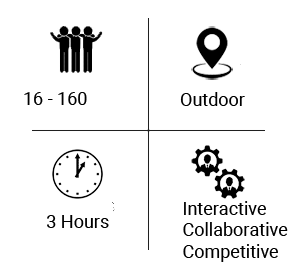
Many company family events work well across a three- to four-hour activity window because families can arrive, eat, try several zones and still have unstructured social time. The exact length should be designed around the venue and audience.
Do we need activities for every age group?
You do not need every attraction to suit every age, but the overall event should offer meaningful choices for younger children, older children, adults and people who prefer lower-intensity participation.
What happens if it rains?
The weather plan depends on the venue and attractions. Some activities may continue in light rain, while wind or poor ground conditions can affect temporary equipment. Agree weather decision points and indoor or modified alternatives with suppliers in advance.
Can Event Square organise catering and entertainment too?
Food and beverages are not automatically included in the core Family Fun Day activity package, but Event Square can coordinate catering with the venue or mobile catering partners and can source additional entertainment and event infrastructure where required.
How early should we start planning a large family day?
Start once the likely date, venue and attendance range are known. Large events can involve multiple suppliers and infrastructure requirements, so earlier planning gives more flexibility around the activity mix and site layout.