Graduate onboarding has a difficult job to do.
A new graduate may be learning the organisation, meeting dozens of people, trying to understand an unfamiliar role and working out how they fit into a team — all at the same time.
That is why a good graduate induction needs more than presentations, policies and a welcome pack. The strongest programmes give new hires opportunities to do something together: communicate, make decisions, solve problems, test ideas, make mistakes and understand how the people around them work.
For Irish employers planning 2027 intakes, this is already a live issue. As of 24 September 2026, major employers including KPMG, Allianz and Kerry are advertising programmes starting in September 2027. Recruitment and onboarding planning increasingly overlap.
The question is not simply how to welcome graduates. It is how to help a group of new starters become comfortable contributing to a team.
What should graduate onboarding actually achieve?
The first days of a graduate programme are often heavily loaded with information. New employees learn about systems, departments, compliance, benefits, career paths, company values and organisational structure.
All of that matters. Information alone does not create connection.
A practical onboarding programme should also help graduates:
- build relationships quickly;
- become comfortable contributing ideas;
- understand different working styles;
- communicate under pressure;
- learn how teams plan and make decisions;
- experience leadership and followership;
- reflect on what effective teamwork looks like;
- create a shared reference point for the months ahead.
This is where experiential learning earns its place in induction. Instead of telling participants that communication matters, put them in a situation where poor communication has an immediate consequence. Instead of explaining delegation on a slide, use a challenge that cannot be completed unless responsibility is shared.
Use the sequence: experience, review, apply
Event Square’s Graduate Grow programme is built around a simple structure:
Experiential task → review of learning → application to the workplace.
Participants work through practical physical, mental and problem-solving challenges, then stop and examine what actually happened.
- Who spoke first?
- Who asked questions?
- Did the team make a plan before acting?
- Was information shared?
- Did one person dominate the process?
- Did the team adapt when the first idea failed?
- Who noticed something everybody else had missed?
The facilitator can then connect those behaviours to situations graduates are likely to encounter at work. The task is the experience; the review is where the learning becomes useful.
Do not make onboarding entertaining all day
Graduate induction does not need to become a theme park. Experiential learning is not about filling every minute with high energy.
A well-designed challenge creates situations worth discussing. One team may begin before fully understanding the instructions. Another may spend too long planning. Another may have one confident participant taking over. A quieter group may discover a more efficient way to work.
Those observations create the material for a useful debrief. The activity does not need to manufacture excitement; it needs to expose real team behaviour in a safe, practical setting.
Vary the challenges so different strengths emerge
If every activity rewards confidence, speed or physical ability, the same people will lead repeatedly.
A stronger programme moves the advantage around the team. One task may reward planning, another spatial thinking, another accuracy, another listening, another physical coordination and another problem-solving under time pressure.
Graduate Grow can include challenges such as Towers of Hanoi, Minefield, Sheep & Shepherd, navigation tasks, construction challenges and other collaborative problem-solving exercises. The exact mix should be selected around the venue, cohort and learning objectives rather than treated as a fixed activity list.
Leadership is not the same as being the loudest person
Graduate programmes often want to develop future leaders. Practical activities can be useful here, but leadership needs to be observed broadly.
The most valuable contribution may come from the person who spots the flaw in the plan, invites a quieter colleague into the discussion, changes direction when new information appears or keeps the group calm as time runs out.
That is a healthier introduction to leadership than simply appointing a captain and rewarding whoever talks most.
Rotate teams during the programme
Allowing the same four or five graduates to stay together all day may create strong small groups, but onboarding usually has a wider objective.
If the cohort is large enough, consider rotating team composition between sections or using challenges that force teams to exchange information. By the end of the day, participants should ideally have worked with considerably more people than the colleagues beside them at breakfast.
That makes the event useful socially as well as developmentally.
Give graduates something to solve before giving them the answer
There is a natural temptation during induction to explain everything.
Experiential learning works differently. Where it is safe and appropriate, give teams enough information to begin and let them encounter the problem.
A team that immediately asks for clarification is demonstrating something useful. So is a team that makes assumptions. So is a team that experiments and adapts.
The review becomes much richer when participants are discussing something they have actually experienced rather than a hypothetical workplace scenario.
Create permission to contribute early
New graduates are often trying to read the room. They do not yet know how much they are expected to speak, which ideas are welcomed or how formal the organisation really is.
A practical team challenge lowers the stakes. Talking about how to move an object, solve a puzzle or navigate a route is easier than offering an opinion in a formal boardroom-style discussion on day one.
Once people have communicated successfully in one context, the barrier to speaking again is often lower.
Where Belbin can add structure
For organisations that want deeper behavioural learning, graduate onboarding can also be combined with The Belbin® Graduate Experience.
The current Event Square programme uses individual Team Role profiles, observer input, team feedback and practical experiential tasks. The aim is to give participants a shared language for discussing how they contribute to teams without reducing people to job titles or simplistic personality labels.
For a graduate programme running over several months, that language can be revisited later rather than disappearing after induction week.
Connect every review to real graduate life
This is where generic fun days can miss an opportunity.
After an activity, ask questions that connect directly to the next few months:
- What happened when information was incomplete? Connect that to starting a first project.
- Who asked for help? Connect that to knowing when to escalate.
- What happened when the first plan failed? Connect that to feedback and iteration.
- Did the team use everybody’s strengths? Connect that to project allocation.
- What would you do differently next time? Create a habit of reflection.
The activity becomes valuable because it provides a shared reference point for conversations later.
A practical graduate onboarding day
A good programme does not need to be complicated.
- Welcome, objectives and safety briefing.
- Light introductory challenge to get people participating quickly.
- Several short experiential tasks with varied skill demands.
- Structured mid-programme review.
- A more complex challenge where teams can apply earlier learning.
- Collaborative finale.
- Final debrief focused on workplace application.
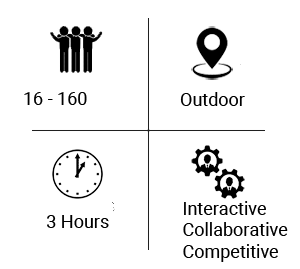
Graduate Grow can run from approximately three hours to a full day depending on the objectives and the wider induction schedule.
Do graduates need a highly physical programme?
No. A graduate cohort can contain a wide range of fitness, mobility, confidence and accessibility requirements.
Physical activity can be useful because it changes the energy after classroom sessions, but it should not be the only route to success. Planning, logic, observation, communication, creativity and accuracy can all form part of the programme.
Accessibility should be discussed during planning rather than dealt with on the morning of the event.
Indoor, outdoor or blended?
All three can work.
An outdoor setting can help separate the experience psychologically from formal induction sessions. An indoor programme is useful where the graduate week is based in an office, hotel or conference venue. A blended format can be especially effective: structured discussion indoors followed by practical tasks elsewhere on the property.
The venue should support the learning objective rather than dictate it.
Use competition carefully
A little competition often creates energy. Too much can distract from the learning.
Competitive tasks can sit alongside collaborative ones. A programme such as Big Picture, for example, creates a different dynamic because smaller groups contribute to one final result.
That can be useful where the organisational message is less about winning and more about contributing to something shared.
Multinational cohorts need clear instructions, not simpler challenges
Many Irish graduate programmes recruit internationally. Instructions therefore need to be concise, visual where possible and easy to demonstrate.
Avoid relying heavily on local slang, cultural trivia or one style of communication. The challenge can remain complex while the explanation stays simple.
Event Square’s Around the World Challenge is another option for highly international cohorts because it varies the type of task rather than rewarding the same ability repeatedly.
A real Event Square example
Event Square’s current IMI Graduate Grow case study describes a two-day graduate development experience for 29 participants across Belmont and Glenview. The programme combined facilitated development sessions with practical team challenges so participants could collaborate, make decisions and reflect on how they worked together.
The important point is not the exact venue or group size. It is the combination of participation, reflection and shared problem-solving rather than separating “learning” and “team building” into unrelated parts of the programme.
What should an employer send the activity provider?
The best graduate onboarding brief is more useful than “send us some team-building options”. Include:
- the size of the graduate cohort;
- whether participants already know one another;
- the wider induction schedule;
- the time genuinely available;
- the venue and room/outdoor space;
- the behaviours or learning objectives you want to develop;
- whether internal L&D facilitators will be involved;
- accessibility requirements;
- whether the event is mainly developmental, social or a combination.
That allows the programme to be designed around the cohort rather than pulled from a generic activity catalogue.
Graduate onboarding should create a reference point
Months after induction, graduates are unlikely to remember every slide they saw during week one.
They may remember the challenge where nobody listened to the instructions, the colleague who spotted the solution, or the moment the team changed its plan and suddenly succeeded.
Those stories become part of the cohort’s shared history. That is where experiential graduate onboarding earns its place: it gives new hires a practical experience of being a team before the real work becomes complicated.
Planning a 2027 graduate onboarding programme in Ireland?
Event Square’s Graduate Grow programme is designed for graduate cohorts, interns, apprentices, new employee groups and early-career teams. Programmes can combine experiential tasks, structured reviews, team-development concepts and facilitated learning at suitable hotels, offices, estates and outdoor venues in Dublin, Wicklow and elsewhere in Ireland.
Start with the learning objectives. The activities can then be designed around them. Contact Event Square with your cohort size, location, timing and what you want new hires to practise in their first weeks.
Frequently asked questions
What is graduate onboarding team building?
Graduate onboarding team building uses practical group challenges during induction to help new hires connect, communicate, solve problems and understand how teams work before applying those lessons in the workplace.
When should team building happen during a graduate programme?
It works particularly well early in the induction period, once essential introductions have been made but before participants have settled into fixed social groups. It can also be revisited later in the graduate programme.
How long should a graduate onboarding activity last?
A short session can introduce connection and communication, while a half-day or full-day programme allows time for repeated tasks, reviews and workplace application. Graduate Grow can run from approximately three hours to a full day.
Can graduate onboarding include formal learning?
Yes. Experiential challenges can be combined with facilitated sessions on leadership, team dynamics, communication or Belbin Team Roles.
Is graduate team building suitable for mixed abilities?
Yes, when the activity mix provides several ways to contribute. Planning, problem-solving, communication, coordination, creativity and observation can be as important as physical participation.
Can graduate onboarding be delivered at our office?
Many programmes can be adapted to suitable offices or company campuses. Hotels, estates, conference venues and outdoor locations can provide additional space where required.
What information should we provide when requesting a proposal?
Group size, date, venue, available time, learning objectives, wider induction schedule and any accessibility or operational requirements are the most useful starting points.