How do you organise team building for a customer-service or contact-centre team when the phones cannot simply be switched off? Build the event around the rota first. Agree how many colleagues can be released, for how long, and where the activity can happen. Then choose a practical format that is comfortable to repeat in smaller sessions if necessary. For many Irish service teams, a low-tech challenge is more workable than assuming everyone can leave the operation for a whole afternoon.
The objective is not to simulate another difficult customer conversation. It is to give colleagues a shared task away from their screens, create interaction beyond the usual shift, and run a programme that respects customer cover and employee time. Event Square offers mobile corporate team-building activities that can be discussed for suitable offices, hotels and conference spaces across Ireland.
What are the best team-building activities for customer-service teams?
| The planning need | Programme to consider | Why it could fit |
|---|---|---|
| One-hour activity during a planned training window | Beat the Clock | Tabletop physical puzzles, construction challenges and a common finish. |
| Team members from several shifts getting together | Big Picture | Smaller groups work on sections of one collaborative artwork. |
| Longer team afternoon away from service operations | Krypton Factor Challenge | Varied mental, physical and observational challenges for an appropriately sized venue. |
| An HR or L&D-led development session | The Belbin Experience | A more structured conversation about teamwork, with preparation and facilitation rather than just a game. |
These formats are not interchangeable. A short shared challenge is often appropriate for a celebration or team introduction; a facilitated development session is better suited to agreed learning goals. Neither should be sold as a guaranteed solution to workload, recruitment or customer-service performance problems.
Design around the shift rota—not around the supplier’s default timetable
Customer-support desks, reservations departments, account-service teams and contact centres may have staggered breaks, specialist queues, variable demand or cover obligations. Ask the operations lead which people can genuinely be released and whether the workload changes across the day. HR may lead the event, but operational management needs to approve the release plan.
Repeatable smaller-group sessions can be useful. They also increase the total period for which the activity provider must be on site. Repetition may mean extra setup, equipment reset, travel or facilitator time; it should be scoped and priced explicitly. Do not assume that three sessions cost the same as one.
A worked scheduling example for 90 participants
Suppose a service department has 90 colleagues but can release only 30 at a time. For an illustrative adapted activity, three waves of 30 might each occupy a 50-minute session, with a 15-minute turnover between waves. That creates a three-hour delivery window from the first session starting to the final session finishing, before initial setup and final pack-down. This is an example for rota planning, not a published Event Square package or promise that every activity can be shortened to 50 minutes.
In practice, one wave may need to start late because a customer queue has not cleared. Build a tolerance into the schedule and identify who can authorise a change. Employees should not be pressured to take part during their own breaks or outside agreed working arrangements simply to make the timetable look convenient.
Why use physical, low-tech challenges for a screen-based team?
For colleagues who work with customer-management systems, headsets, phone lines and screens, an activity with physical materials can feel like a meaningful change of pace. Puzzle cards, wooden blocks, construction pieces, clues, artwork and paper score sheets create something tangible to discuss. Participants can test a solution, move pieces, swap roles and work together without another login or phone app.
Low-tech does not mean leaving people alone with a box of games. A facilitator has to explain the activity clearly, manage the time, make the scoring understandable and ensure groups are not excluded because they are less loud or competitive. The objective should be genuine participation, not a public ranking of who is the ‘best agent’.
Beat the Clock: a short, contained energiser
Beat the Clock is listed by Event Square as a one-hour challenge with puzzles, time management and problem-solving. Teams can work around tables rather than moving around a large outdoor site. When planning around shifts, confirm the availability of a suitable room, table layout and staff time for arrival and departure. One hour of activity should not be mistaken for one hour covering the entire supplier load-in, briefing, delivery and room reset.
Big Picture: a shared creative result
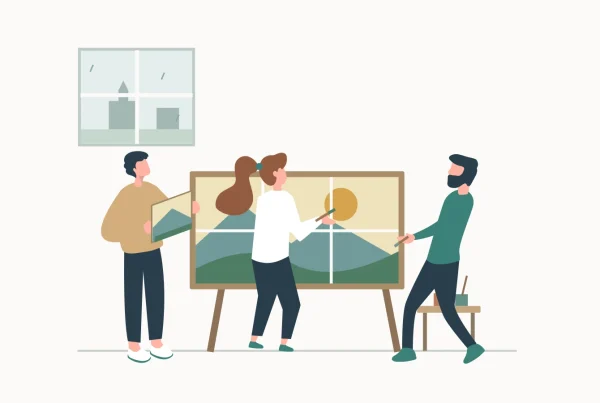
With Big Picture, each team paints a portion of a larger piece. Groups need to coordinate colours and edges so the final result fits together. It provides a different type of collaboration from a race or quiz, and allows a range of roles: planning, painting, checking, organising and assembling. However, it uses real materials and needs protected tables, space, careful canvas handling and a longer uninterrupted block than a short rota gap.
Krypton Factor: more movement, more venue planning
Krypton Factor Challenge mixes different styles of problem-solving and physical activity. It may suit a team day where colleagues have genuinely been released from live operations, but the selected stations must fit the space and participant mix. A meeting room set up with tightly packed tables is not automatically suitable for active challenge rotations.
How to make the activity inclusive
Customer-service teams can have colleagues on different shifts, of different ages, with varied mobility and sensory needs, and with different levels of confidence using English in a fast-moving group. Choose tasks that allow several meaningful roles, not just the fastest speaker or strongest participant. Offer a clear briefing, seated participation where appropriate, accessible movement routes and realistic noise levels.
Mixing shifts is useful when colleagues rarely meet, but do not automatically separate new joiners from the few teammates they know. Assign groups deliberately. If the event has an accessibility or dietary requirement, agree privately how the venue and provider will accommodate it without asking anyone to explain personal circumstances publicly.
Do supervisors participate or run the session?
Make that decision in advance. One supervisor may need to remain responsible for customer escalation and service coverage while another joins the group. If a manager attends as a participant, avoid appointing that manager to lead every task; otherwise the activity simply recreates the normal reporting structure.
Where the objective is more substantial—for example, an HR-led discussion of team contributions and working preferences—consider a properly prepared Belbin Experience. That type of facilitated development is a different brief from a celebratory team game and needs appropriate planning. It should not be squeezed into a quick shift-change slot.
Do not use team building as a substitute for managing workplace stress
Ireland’s Health and Safety Authority identifies workload, work patterns, communication and managerial support among the factors associated with work-related stress. A fun afternoon cannot resolve inadequate staffing levels, unreasonable demands or poor work organisation. If those issues are present, the employer needs to address them through appropriate management and workplace processes independently of the event.
The Workplace Relations Commission’s Right to Disconnect Code of Practice is also relevant when colleagues work mixed or unsocial shifts. Organisers should respect boundaries outside agreed working hours, and avoid presenting attendance on a rostered day off as a routine expectation.
Office, hotel or offsite venue: which works best?
| Location | Potential benefit | Important check |
|---|---|---|
| Office training room | No coach or group transfer; easier to run rota waves | Noise, movement, loading access and service interruptions |
| Nearby hotel meeting space | Separation from the everyday work setting | Room hire, transport, catering and actual usable area |
| Dedicated away-day venue | Space for a longer, varied programme | Approved service cover, travel time and a reliable return plan |
When inspecting the location, request dimensions of the usable floor area, not just a headline delegate capacity. Tables, storage, staging, refreshments, access paths and fire exits affect how many stations can be run safely. If the group is split across Dublin, Cork or Galway, bringing everyone together and delivering separate local sessions are different cost and staffing scenarios; simultaneous multi-site delivery needs specific confirmation.
A realistic enquiry checklist for customer-service managers
- Attendance: total number invited, expected attendance and maximum number released per wave.
- Timing: paid working time, rota constraints, handover time and the day of the week.
- Objective: celebration, introductions, a morale-focused social activity or facilitated team development.
- Space: room name, dimensions, tables, access, noise restrictions and furniture reset.
- Inclusivity: accessibility needs and different ways of contributing to the challenges.
- Operational contingency: who decides if demand delays a wave or requires a session adjustment?
- Costs: number of sessions, facilitators, equipment, venue, travel, refreshments and room hire.
The quotation should clearly describe what is included and which parts are supplied by the office, hotel or another provider. A per-person figure alone is not enough to compare a single afternoon session against multiple short delivery waves.
Frequently asked questions about contact-centre team building
Can Event Square bring team building into a contact-centre office?
Event Square offers mobile corporate activities for suitable workplaces. The chosen programme, room, participant numbers and access arrangements must be checked before delivery is confirmed.
What activity works if we have only an hour?
Beat the Clock is a practical option to discuss because its published format is one hour. Remember to plan arrival, equipment setup, movement and room reset separately unless the supplier confirms otherwise.
Can the same programme be delivered several times for different shifts?
Potentially. Ask for a proposal covering every session, participant wave, turnover period, total on-site hours and staffing requirements. Repeated delivery is not automatically the same price as one session.
Can an event guarantee higher customer satisfaction or staff retention?
No. A team challenge can be designed for participation and connection, but it cannot guarantee changes in service or employment outcomes.
Is competition suitable for teams under high pressure?
Not necessarily. A more collaborative format may be preferable. Serious workload or management issues should be addressed separately through the employer’s own processes.
Can supervisors and agents take part together?
Yes, where operational cover permits. Define the managers’ responsibilities first and allocate teams so participation is genuinely shared.
Can we run an event for people from several Irish locations?
It is possible to discuss a central venue or individual local sessions. Travel, cover and the logistics of any simultaneous events must be confirmed before promises are made.
What information does Event Square need for a quotation?
The date, venue or county, headcount, number of staff waves, activity window, objectives, room details and any additional access or participation requirements.
Build a team day that works with the rota
The best first message from a service manager is often simple: ‘Here is how many colleagues we can release, for how long, and in which room.’ Event Square can then discuss a low-tech format and delivery plan suited to the actual operation. Contact Event Square, compare our team-building activities or read the related guide to office team building in Dublin.