A Belbin team development workshop is designed to help colleagues discuss how they contribute to a team, understand differences in working behaviour and put that learning into practice. It is not simply a personality quiz followed by games. For Irish HR, learning and development, and leadership teams, the important question is whether you want a fun shared experience, a structured development intervention—or a deliberate combination of both.
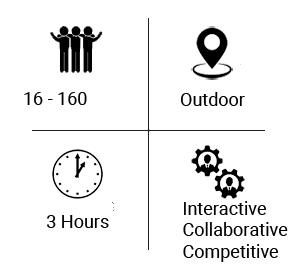
Event Square’s Belbin® Experience combines Belbin Team Role profiles and facilitated feedback with practical experiential challenges. It can form part of a leadership offsite, an established team’s development day or a graduate programme at a suitable office, hotel or conference venue in Ireland.
What is the difference between Belbin and ordinary team building?
A social team-building event usually starts with the experience: colleagues solve a problem, play a game, take on a challenge or create something together. The aim may be to connect people, mark an occasion or give teams time away from their desks. Success might look like enjoyable participation and better acquaintance across departments.
A Belbin-led development day starts with a specific workplace question. Why do meetings stall? Are people unclear about how they contribute? Does the team generate ideas but struggle to implement them? Are colleagues interpreting different working behaviours as personal failings? The programme then uses a shared language, feedback and guided reflection to examine those questions.
The two formats are not mutually exclusive. Indeed, bringing a practical challenge into a facilitated session gives people a chance to observe how planning, listening, coordination and follow-through play out in real time. But the debrief and application back to work are what distinguish a development day from a general fun day.
What does Belbin measure?
Belbin describes nine Team Roles—clusters of useful workplace behaviour grouped into Social, Thinking and Action roles. They include ways people bring ideas, examine options, coordinate work, support colleagues and complete tasks. The framework is about behaviour and contribution, not assigning people a fixed personality label. According to Belbin’s own explanation, it is not a personality test or a psychometric test.
A colleague may contribute more than one Team Role, and different projects may call for different behaviours. The purpose is not to assemble exactly one person for each of the nine categories or to use a profile as a ranking of who is “best”. Belbin’s official Team Roles guide explains strengths and allowable weaknesses and why no single role should be considered in isolation.
This distinction matters in a corporate setting. A team should be able to ask, “Which contributions are we relying on too heavily?” without turning the discussion into “You are the kind of person who always does X.” Useful feedback makes working relationships easier to discuss; careless labelling can do the opposite.
How does the Event Square Belbin Experience work?
The published Event Square programme has a preparation stage, facilitated feedback and practical team activities. The precise agenda is shaped around the group’s objectives and the selected venue.
1. Agree the development brief
Begin with a planning conversation. Is this a new leadership team, a graduate cohort, colleagues after a restructure or a project group trying to work better together? The answer changes both the questions to explore and the intensity of the debrief. “We want everyone to get on better” is understandable, but it is easier to design a session around specific habits such as clearer decisions, better handovers or involving quieter contributors.
2. Complete the self-perception stage
Participants complete Belbin’s Self-Perception Inventory (SPI) before the session. It asks them to reflect on how they tend to behave and contribute when working with others. This should not be squeezed into the final five minutes of a conference or announced to staff with no explanation of why their input is requested.
3. Add observer feedback where appropriate
Participants may invite colleagues who know their work to contribute Observer Assessments. The Belbin guidance on observer feedback recommends inviting six observers and requires at least four for a report incorporating observer data. That detail is useful when planning deadlines and identifying people who have actually worked together long enough to give meaningful feedback.
Observer responses can reveal differences between how we believe we contribute and how others experience us. The facilitator’s job is to make those differences useful rather than embarrassing. HR should agree how the reports will be shared, who will see them and how the findings will—and will not—be used.
4. Review individual and team patterns
Profiles and the team report provide a basis for discussing collective strengths, gaps, overlaps and communication. Teams might discover that they are quick to generate possibilities but do not consistently allocate responsibility for delivery, or that useful challenges to ideas are being interpreted as negativity. These are examples of possible discussion points, not a promise that a profile will diagnose a team’s problems.
5. Test the learning with practical activities
Event Square adds hands-on tasks involving planning, communication, problem-solving and shared decisions. A team may need to interpret a brief, allocate limited materials, adapt when an approach fails and agree a workable final answer. Different tasks create opportunities for different people to contribute. Following the task, the facilitator helps the group examine how it worked—not simply whether it won.
This is where Event Square’s low-tech approach makes sense: physical tasks create visible choices and conversations. The activity is a learning vehicle, not the end goal.
Who should choose a Belbin-led team development day?
Leadership and senior management teams: useful when a group needs to clarify how decisions are made, balance different contributions and make difficult conversations more constructive. It should complement, rather than replace, the actual strategic work of a leadership offsite.
Newly assembled project teams: appropriate when people from operations, finance, sales or delivery need to work together without yet knowing one another’s working styles. Frame the session around handovers, ownership and communication rather than vague promises of instant high performance.
Graduate and onboarding groups: a way to introduce reflection on team contribution alongside the shared tasks of an early-career programme. For a broader practical onboarding programme, compare Graduate Grow and our graduate onboarding planning guide.
Established teams dealing with tension: a facilitator can help people discuss work behaviours in less personal terms. However, Belbin is not mediation, a clinical assessment, or a replacement for properly handling serious workplace grievances. Where there are active disputes, the brief should be carefully assessed before proposing a group exercise.
When is a lighter team-building event a better choice?
Belbin needs honest preparation, suitable facilitation and time for reflection. It may be the wrong format for a staff Christmas party, a 45-minute conference gap or an event whose main purpose is thanking people after a busy year. Participants also need to know that a development session is planned—not discover halfway through a fun day that their behaviours are being analysed.
For a shorter, more social outcome, Big Picture offers a shared creative project. Krypton Factor Challenge provides mixed practical challenges, while Wacky Races offers a competitive build-and-race finale where a suitable outdoor area is available. The key is to separate social connection from facilitated behavioural development, even when an event can contain elements of both.
How to plan a Belbin workshop in Dublin or elsewhere in Ireland
The venue does not need to be remote or luxurious. It does need to support focused conversation, breakouts and the experiential portion of the programme. A city-centre meeting room with fixed theatre seating may be adequate for a presentation but poor for small-group reflection and physical tasks.
For a suitable hotel, office or estate, ask about natural light, chairs and tables that can be rearranged, sufficient space between groups, access to nearby activity space if required, a private area for sensitive conversations, sound separation, accessible routes and a reliable schedule for refreshments. Avoid assuming that “capacity for 60 delegates” means 60 people can comfortably rotate through team challenges in the same room.
Event Square delivers across Ireland and can help source venues for the Belbin Experience. For further practical questions about combining meeting rooms and activities, see our hotel team-building planning guide.
A sample one-day Belbin and experiential learning agenda
The following schedule is illustrative. It is not a fixed published package or a commitment to particular exercises. The balance between report feedback, practical work and debrief should follow the team’s needs.
| Time | Possible session | Purpose |
|---|---|---|
| 09:00 | Welcome, objectives and working agreements | Make the purpose and boundaries clear |
| 09:30 | Belbin Team Roles and profile discussion | Establish the shared language |
| 10:45 | Break | Allow reflection before applying the learning |
| 11:00 | Small-team experiential challenges | Notice behaviours during real collaboration |
| 12:30 | Debrief and lunch | Connect observed habits to daily work |
| 14:00 | Second challenge or team planning exercise | Test different approaches and role allocation |
| 15:15 | Team commitments and next steps | Agree practical actions and owners |
| 16:00 | Close | Confirm how the learning will be revisited |
Not every team needs a full day. Equally, a ten-minute introduction to Belbin is not equivalent to a programme with preparatory profiles, observer input, facilitated feedback and experiential work. Ask for a scope that states exactly what preparation and follow-up are included.
How should HR handle privacy and participant confidence?
A behavioural profile belongs in a respectful development setting. Give participants clear information about the purpose of the exercise, what they will complete beforehand, who receives their results and what opportunities there are to ask questions. Avoid displaying individual reports in a room without agreement or using them as an informal performance ranking.
It also helps to agree a few working rules: colleagues describe what they observed rather than labelling people, participants can challenge an interpretation, and a profile does not override an individual’s own context or experience. If assessment results could be relevant to employment decisions or records, the organisation should check its own HR and data-protection processes. A team workshop is not, by itself, an employment-selection assessment.
How do you know whether the workshop was useful?
A stronger evaluation question than “Did everyone enjoy it?” is “Did we agree to change anything about how we work?” At the end of the day, ask the team to choose two or three observable commitments: for example, naming an owner for decisions, seeking a different viewpoint before committing to a plan, or allocating time to check details before delivery.
Assign responsibility and a check-in date. A four-week review might ask whether the new habit happened and what got in the way. These are sensible measurement practices, not evidence that any one workshop guarantees greater retention, profitability or team performance. Real improvement requires managers and colleagues to practise the changes after the event.
What should be included in your Belbin workshop quotation?
When asking Event Square for a proposal, share the team size, seniority, approximate location, proposed date and why the workshop is being considered. Mention if participants already know Belbin or if this will be their first experience. Other useful details include whether the group is based in one office or spread across regions, whether observers can be recruited in time and whether the activity needs to run before dinner or as part of a residential programme.
The published programme includes facilitated team development, Belbin work and experiential activities, supported by event planning and venue sourcing where needed. Venue hire, food, drinks and transport should not be assumed included. The exact participant process and any reporting requirements need to be agreed in the proposal; do not treat website guide pricing as an all-inclusive quote.
Frequently asked questions about Belbin workshops in Ireland
Is a Belbin workshop a personality test?
No. Belbin’s own guidance describes Team Roles as observable workplace behaviours rather than a fixed personality classification. Profiles support discussion; they should not be treated as diagnostic labels.
Do all nine Belbin Team Roles need to be present in a group?
No. Individuals may contribute several roles, and the behaviours a team needs vary by task and context. A workshop explores the mix of contributions rather than requiring exactly nine people.
What should participants do before the session?
Participants generally complete the Self-Perception Inventory, with Observer Assessments where relevant. The final preparation instructions and deadlines should come from the facilitator organising the programme.
Can Event Square combine Belbin with hands-on team building?
Yes. The Event Square Belbin Experience is specifically designed to bring facilitated feedback together with practical experiential tasks and debriefing.
Does a Belbin workshop suit a new graduate cohort?
It can, when the objective is self-awareness and working effectively with others. For a broader onboarding experience, Event Square also offers Graduate Grow.
Can a Belbin workshop be held in a Dublin hotel?
Potentially. A suitable room layout, confidentiality, breakout arrangements and space for the selected practical tasks need to be confirmed before booking.
Is this suitable for a team with serious conflict?
It may support constructive discussion of working behaviours, but it is not a substitute for formal grievance procedures, independent mediation or professional support where those are required.
Is venue hire included in the price?
Not automatically. Event Square’s programme information treats venue hire, catering and transport as separate unless specifically included in the agreed quotation.
Plan an experiential Belbin team day with Event Square
Tell us what is happening in your team, what you want people to do differently after the session, where your colleagues are based and when you would like to meet. We can discuss whether a Belbin-led programme, a practical Graduate Grow session or a lighter team-building activity fits the brief. The right answer is the experience that matches your people and goals—not simply the most elaborate agenda.