Most corporate teams spend enough of the working week looking at screens. A team day does not have to add another app, QR code, leaderboard or stream of notifications. For many groups, the better contrast is something deliberately hands-on: real materials, face-to-face problem solving, movement, conversation and a shared challenge.
That is the thinking behind screen-free team building. It is not anti-technology and it does not require everyone to hand over their phones. It simply makes the experience itself work without depending on a device.
Quick answer: what is screen-free team building?
Screen-free team building is a corporate activity designed around direct human interaction rather than phones, tablets or laptops. Teams might paint, build, navigate, solve clues, compete in traditional games, make music or work through practical challenges together. The best formats give people different ways to contribute, so success is not based only on fitness, confidence or technical skill.
For Event Square, low-tech does not mean basic. The event can still be professionally planned, facilitated, scored and tailored. The difference is that the technology stays in the background while the people do the work.
Why companies are asking for more off-screen experiences
Hybrid meetings, collaboration platforms and remote work are useful, but they also mean colleagues can spend much of their working relationship communicating through a device. When a team finally gets together in person, simply recreating that same digital environment can miss the point.
Ireland’s Workplace Relations Commission has had a formal Code of Practice on the Right to Disconnect since 2021. That code is about working-time boundaries rather than team events, but it is a useful reminder that “always on” does not need to be the default for every work interaction.
A well-designed team day can create a different rhythm: colleagues talk without a chat window, solve something together without searching for the answer, and notice strengths that are not always obvious in a meeting.
Seven low-tech team-building formats that work well in Ireland
1. Big Picture
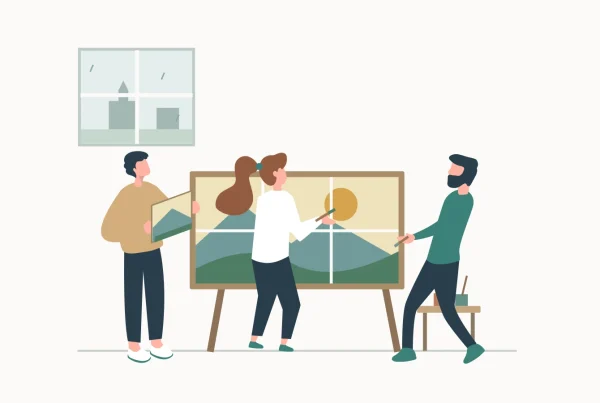
Big Picture is a collaborative creative challenge where small teams paint individual sections that eventually join to form one large final artwork. Because no single team sees the complete image at the start, communication between groups matters as much as the painting itself.
It works particularly well for groups that want a shared result at the end of the session rather than a winner-and-loser format. It is also a strong indoor option for hotels, conference venues and company spaces with suitable room layout.
2. Old School Sports Day
For companies that want something energetic but deliberately uncomplicated, Old School Sports Day brings back familiar challenges such as relays, sack races, egg-and-spoon races and tug of war, with the event structured around teams and activity zones.
The appeal is partly nostalgia, but the format is useful because the rules are easy to understand. People can get involved quickly without learning an app or complicated scoring system.
3. Paper-based treasure hunts
A treasure hunt is naturally social when the route is built around printed clue books, maps, observation tasks and problem solving. Event Square’s Dún Laoghaire Code Breaker Treasure Hunt, for example, is intentionally screen-light and uses the harbour and town as part of the challenge.
For groups based in Dublin city, the Discover Dublin Treasure Hunt uses city zones, riddles, team tasks and cultural landmarks. The practical advantage of this style of event is that the group is looking at the place and at each other rather than following a phone around the route.
4. Celtic Games
Celtic Games combines traditional Irish-themed challenges with team rotation and friendly competition. Depending on the programme, activities can include turf stacking, horseshoe throwing, wellie throwing, archery and a group finale.
This is a particularly useful format when an Irish element matters to the event, including domestic company days and international groups visiting Ireland. The activities themselves are physical and tangible, so the cultural theme is experienced rather than delivered as a presentation.
5. The A-Team Challenge
The A-Team Challenge blends practical, physical and problem-solving activity zones. The important part is the mix: one challenge may reward planning, another coordination and another hands-on problem solving.
That variety is useful for mixed groups because it avoids designing the entire event around one type of participant. For a team-building day to feel inclusive, there should be more than one way to be useful.
6. Bushmaster Survival Challenge
The Bushmaster Survival Challenge combines practical outdoor tasks with bushcraft and open-fire cooking. Teams have to divide roles, make decisions and work with real materials rather than simulated tasks on a screen.
It suits groups looking for a stronger outdoor challenge and needs the right venue, conditions and event plan. It is not a universal option for every team, which is exactly why matching the activity to the group matters.
7. Group rhythm and music
Music can create a low-tech shared experience without making the event overly competitive. A bodhrán workshop uses live facilitation, rhythm and active listening, while BoomBoom uses boomwhackers as a conference energiser.
These formats can work well when the objective is to bring a room together quickly or add a collaborative activity to a conference, meeting or wider company day.
Screen-free does not mean “phones are banned”
One of the easiest ways to make an off-screen event feel forced is to turn it into a rule-enforcement exercise. People may need phones for travel, childcare, accessibility, work emergencies or simply coordinating their day.
A better approach is to design an activity that does not require the phone in the first place. If the challenge is engaging enough, most people naturally put the device away because their attention is needed somewhere else.
How to make low-tech team building inclusive
- Mix challenge types. Do not make every station a race, strength test or public performance.
- Give teams different roles. Planning, observing, building, presenting, navigating and scoring can all matter.
- Build in breaks. Continuous activity is not automatically better activity.
- Check the venue properly. Indoor room dimensions, outdoor ground conditions, loading access and weather fallback all affect what is realistic.
- Avoid compulsory embarrassment. Friendly competition is useful; putting reluctant participants on the spot rarely is.
- Plan around the whole event. The activity should connect naturally with meetings, food, transport and the rest of the day.
Indoor or outdoor: which low-tech format should you choose?
If you already have a hotel or conference room, a collaborative creative or musical format may be easiest. If the venue has usable outdoor space, a multi-activity challenge or sports-day format opens up more options. If the group wants to explore a destination, a well-designed treasure hunt can turn the location itself into the activity.
For wider planning advice, see our guides to team building at hotels in Ireland, outdoor team building in Ireland and team building at your Dublin workplace.
What we would avoid
Low-tech team building works best when it is an event design choice, not a gimmick. We would avoid making the day about confiscating phones, forcing every participant into the same physical activity, or filling every minute with competition. We would also avoid choosing an activity first and trying to make the venue fit afterwards.
The practical sequence is simpler: decide what you want the team to get from the day, understand the group profile and venue, then choose the activity format that fits.
Frequently asked questions
Are phones completely banned during screen-free team building?
No. A screen-free event simply means the activity itself does not depend on a phone, tablet or laptop. Participants can still keep their phones for practical or personal reasons.
Is low-tech team building suitable for technology companies?
Yes. In fact, an off-screen format can provide a useful contrast for teams whose normal work is highly digital. The right choice depends on the people, venue and objective rather than the industry.
Can screen-free team building be done indoors?
Yes. Big Picture, music and rhythm sessions, practical team challenges and other facilitated formats can work indoors when the room is suitable. Always check space, access and layout before confirming an activity.
Can low-tech formats work for large groups?
Yes, but the event needs the right structure. Large groups usually work better with multiple activity zones, clear rotations, team allocation and enough facilitation. See our large-group team-building guide for more planning detail.
What happens if the weather changes?
That depends on the activity and venue. Some events can continue in light weather, while others need an indoor alternative or a revised programme. Weather planning should be agreed before the event rather than decided on the day.
Planning a screen-free team day in Ireland?
Event Square designs and delivers corporate team building across Dublin, Wicklow and throughout Ireland. If you tell us your group size, date, location and the kind of experience you want, we can help you narrow the options to a format that suits the people and the venue.
Start with our Team Building Guide Ireland 2026/2027 or explore the current activities on Event Square.